Integrated Health Sciences Journal (IHSJ)
ISSN: 3106-7050 - 3106-7069

Peer Review Process & Policy
Reviewing requires the investment of time and a certain skill set. Before you decide to accept a request to review, you might want to know more about the peer review process and how to conduct a review.
Reviewers evaluate article submissions to journals based on the requirements of that journal, predefined criteria, and the quality, completeness and accuracy of the research presented. They provide feedback on the paper, suggest improvements and make a recommendation to the editor about whether to accept, reject or request changes to the article. The ultimate decision always rests with the journal’s editor but reviewers play a significant role in determining the outcome.
The role of a reviewer, particularly in academic publishing, is crucial to maintaining the quality and integrity of the research being published. Here are some key responsibilities of a reviewer:
Responsibilities of Reviewers
IHSJ undertakes a very serious double-blind peer-review process and carefully selects reviewers for submitted manuscripts from among the top scholars in the field. Reviewers must fulfil the following criteria:
If, for any reason, a reviewer is unable to review the manuscripts after accepting the invitation or suspects a potential conflict of interests, he/she should inform the Editor immediately.
Reviewers will be formally asked to review the assigned manuscripts by the Editor and shall submit their review reports within 2 weeks of the submission deadline.
Reviewers in academic and scientific publishing play a critical role in ensuring the quality, accuracy, and integrity of published work. Their responsibilities are as follows:
Reviewers help ensure the reliability and relevance of research before it is made available to the wider scientific and academic community.
The peer-review process
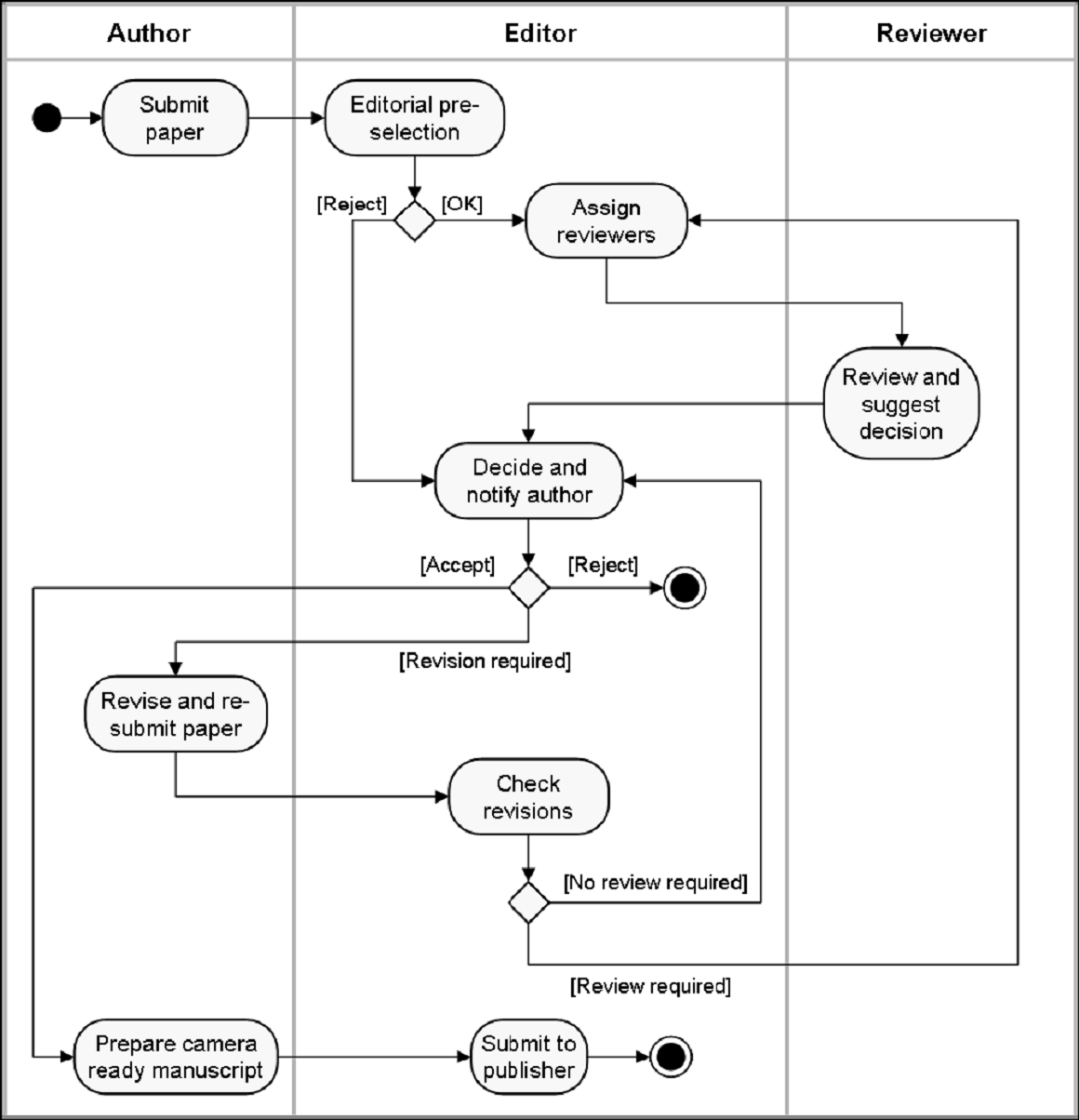
Reviewers Process
Criteria for judging a paper
Peer Review Policy
Once a manuscript clears the initial screening, it is sent for peer review.
We use a review process in which the names of reviewers and authors are not revealed to each other. Generally, we send the article to 2 reviewers.
If you accept, you must treat the materials you receive as confidential documents. This means you can’t share them with anyone without prior authorization from the editor.
Your review will be managed via the IHSJ OJS submission system. The IHSJ accepts articles via OJS (open journal system).There is a generic login link for each article. To access the paper and deliver your review, click on the link in the invitation email you received, which will bring you to the submission and review system.
When you sit down to write the review, make sure you familiarize yourself with journal-specific guidelines (these will be noted in the journal’s guide for authors available on the link). First, read the article. You might consider spot-checking major issues by choosing which section to read first. Below, we offer some tips about handling specific parts of the paper.
The Review: When reviewing the article, please keep the following points in mind.
Originality:
This manuscript is a valuable addition to the literature. Is the question original and well defined? Do the results provide an advance in current knowledge? Is the English language appropriate and understandable?
Significance:
Are the results interpreted appropriately? Are they significant? Are all the conclusions justified and supported by the results?
Quality of Presentation:
Is the article written in an appropriate way? Are the data and analyses presented appropriately?
Scientific Soundness:
Interesting for the reader: Are the conclusions interesting for the readership of the journal? Will the paper attract a wide readership, or be of interest only to a limited number of people? (Please see the Aims and Scope of the journal.)
Overall merit/benefit of the research:
Is there an overall benefit to publishing this work? Does the work provide an advance towards current knowledge? Do the authors have addressed an important long-standing question with smart experiments?
Title Page: The title page includes the manuscript's title, authors' qualifications, department, and email address, correspondence, and funding source, number of figures, tables, word count, and page count.
Abstract: This should be an accurate summary of the complete work that includes statements about the problem, the research methods, the findings, and the conclusions. The abstract can only be 250 words long.
Keywords: Supply a list of three to eight key words (it is okay to repeat words in the title), pertinent to the article, which will appear below the abstract and will be included in the index at the end of the volume.
Review articles or Case report: Authors of case reports or review articles must include summary, methods for data collection, databases searched, and time period, along with a brief abstract, and manuscript.
Introduction: The manuscript introduction should provide a concise summary of the study's purpose and rationale, without extensive review or data or conclusions.
Method: The methodology section should include the exact method, design, Obsolete terms such as retrospective studies should not be used. The selection of the observational or experimental subjects (patients or experimental animals, including controls) should be described clearly. The methods and the apparatus used should be identified (with the manufacturer’s name and address in parentheses), and procedures described in sufficient detail to allow other workers to reproduce the results. The population, sampling, sample size, instrument reliability and validity, data collection procedure, consent form should be clear. All drugs and chemicals used should be identified precisely, including generic names(s) dose(s) and route(s) of administration. Ethics Committee/Institutional Review Board approval number with date.
Results: The manuscript should include interpretation of the results, tables, and, graphs or figures, with table numbers and sub-headings for clarity. The authors should add frequencies distribution, descriptive statistics, and inferential statistics with details. Additional materials and technical details can be placed in an appendix, accessible in the electronic version. Table and Illustrations: Tables and illustrations should be merged within the text of the paper and legends to illustrations should be typed on the same sheet. Tables should be simple and should supplement rather than duplicate information in the text; tables repeating information will be omitted. Each table should have a little and be typed in double space w=without horizontal and vertical lines on the paper. Tables should be numbered consecutively with Roman Numerals in the order they are mentioned in the text. Page number should be in the upper right corner. If abbreviations are used, they should be explained in footnotes and when they first appear in text,. When graphs, scattergrams, or histograms are submitted, the numerical data on which they are based should be supplied. All graphs should be made with MS Excel and be sent as a separate Excel title even if merged in the manuscript. For scanned photographs highest resolution should be used. Figures and Photographs: Figures and photographs should only be sent when data can not be expressed in any other form. They must be unmounted, glossy prints in sharp focus. They may be in black and white or in colour. Negatives, transparencies, and x-ray films should not be submitted. The number of the figure, the name of the author(s) should be printed on the back of each figure/photograph. The top of the figure must be identified by the author. These figures and photographs must be cited in the text in consecutive order. Legends must be typed on the same paper. Legends for photomicrographs should indicate the magnification, internal scale and the method of staining. Photographs in published articles will not be returned.
Discussion: The focus here should be on the current findings as well as any differences or overlaps with earlier work in the field by other researchers. Don't bring up specific information again in the discussion. Draw attention to the study's novel and significant elements and the conclusions that flow from them. It must be stated whether the article's hypothesis is accurate, incorrect, or whether no conclusions can be drawn.
Conclusion & Recommendations: The author should conclude properly, as the base of the findings and the study should meet the research objectives. The recommendations should be added properly.
References: Authors should type references in superscript. Maximum references: original investigation 40, reviews 40, short communication 20, case reports, letter to editors, editorial board 15. These citations need to be noted in the text as well. By conducting a thorough literature search, the author should make sure to cite any locally published studies. The editor and reviewers might not be able to verify the validity of all reference citations in APA style. The authors should follows the International Committee of Medical Journal Editors (ICMJE) authorship guidelines
SUBMISSION
The authors must make sure the manuscript is accurate and full before submitting it. The manuscript cannot be retracted after receiving a "accept" decision. Any requests for withdrawals made after acceptance must have a compelling reason, and the Editor-in-Chief and publisher will evaluate them.
All manuscripts should be submitted electronically via the Open Journal System (OJS). You may check the status of your submission at any time by logging on to submission.For technical help with the submission system, please review our contact editor@theihsj.com or ihsjournal16@gmail.com
Format submission
Before you submit, you will need to follow these instructions for your manuscript:
Plagiarism: Using software called Turnitin, manuscripts are checked for plagiarism, and those who are found guilty or who engage in publication misconduct risk being blacklisted.
Copy Right: Material printed in this journal is the copyright of the IHSJ and may not be reproduced without the permission of the editors or publishers.
The title page of the manuscript, including:
Statements relating to our ethics and integrity policies, which may include any of the following:
Data availability statement
General Requirements: Manuscript must be written in ‘English’. Non-native English speakers must seek the assistance of experienced, English-speaking medical editors if in doubt. Taking feedback from your colleagues also makes the manuscript writing more productive, versatile and simple for the readers.
Special Instructions: The editorial board of IHSJ appreciates the efforts of The EQUATOR (Enhancing the Quality and Transparency of Health Research) Network for promoting good reporting of research. It has played a pivotal role in development, dissemination and implementation of reporting guidelines throughout the world.
To submit, login at Open Journal System (OJS) and create a new submission. Follow the submission steps as required and submit the manuscript.
Ethical considerations in research are a set of principles that guide your research designs and practices. Scientists and researchers must always adhere to a certain code of conduct when collecting data from people.
The goals of human research often include understanding real-life phenomena, studying effective treatments, investigating behaviors, and improving lives in other ways. What you decide to research and how you conduct that research involve key ethical considerations.
These considerations work to
If tables, illustrations or photographs, which have already been published, are included, a letter of permission for republication should be obtained from author(s) as well as the editor of the journal where it was previously published. Written permission to reproduce photographs of patients, whose identity is not disguised, should be sent with the manuscript, otherwise the eyes will be blackened out.
Complete Manuscript Submission Checklist
Submission of manuscript will considered complete if the following is attached with the submitting article. Sequence of sections of the article must be strictly followed as below:

Integrated Health Sciences Journal (IHSJ) is published by Research Academy for Advancement and Hope (RAAH).
Office: House#43, Liaqat Tubewell street main aqwal road, Talagang Contact: editor@theihsj.com

This work is licensed under a Creative Commons Attribution-NonCommercial 4.0 International License.